

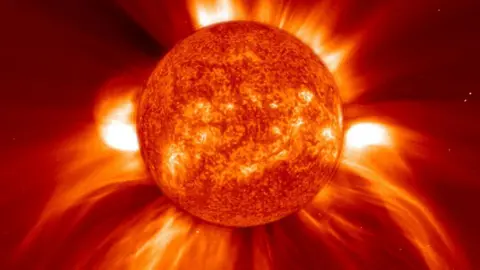
For Aditya-L1, 2026 will be like no other.
This marks the initial occasion the spacecraft – which was placed into space last year – will be able to observe our star when it reaches its maximum activity cycle.
According to research, this occurs roughly once every 11 years as the Sun's magnetic poles flip – a similar Earth scenario could be the North and South poles changing places.
This period marked by intense activity. It sees the Sun changing from peaceful to violent and is marked by a significant rise in the number of solar storms and coronal mass ejections (CMEs) – massive bubbles of fire that blow out of the Sun's outermost layer.
Composed of charged particles, a CME may have a mass up to a trillion kilograms and reach a speed exceeding 2,000 miles each second. It can head out in any direction, even toward our planet. At top speed, it would take a CME 15 hours to cover the 150 million km Earth-Sun distance.
"In the normal or low-activity times, the Sun emits two to three CMEs a day," explains a leading scientist. "Next year, we expect there will be over ten daily."
Researching CMEs is one of the most important scientific objectives of India's maiden solar mission. Firstly, as these eruptions offer a chance to study the Sun at the centre of our planetary system, and secondly, because activities occurring on the solar surface threaten infrastructure on Earth and in space.

Effects on Earth and Orbital Systems
Coronal mass ejections seldom present immediate danger to people, yet they impact our planet by causing geomagnetic storms that impact conditions in near space, where nearly thousands of spacecraft, comprising many from India, are stationed.
"The most spectacular manifestations from solar eruptions are auroras, being direct evidence that charged particles from our star journey toward our planet," the expert explains.
"However, they may make all the electronics aboard spacecraft malfunction, disable power grids and disrupt meteorological and telecom spacecraft."
Past Solar Events
- The strongest solar storm ever recorded occurred during the 1859 solar superstorm which knocked out communication systems worldwide
- During 1989, sections of Canadian electrical network was knocked out, leaving six million people without power for nine hours
- In November 2015, solar activity disrupted flight operations, causing chaos in Sweden and various European air hubs
- Recently in 2022, an ejection had led to dozens of spacecraft being lost
With capability to see what happens in the solar atmosphere and detect a solar storm or a coronal mass ejection as it happens, measure its heat at the source and watch its trajectory, it can work as a forewarning to switch off electrical systems and spacecraft redirecting them out of harm's way.
The Mission's Special Capability
There are other solar missions observing the Sun, Aditya-L1 holds an edge over others regarding studying the solar atmosphere.
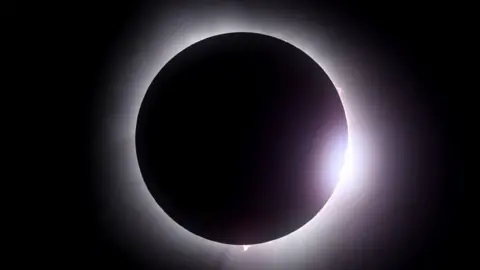
"Aditya-L1's coronagraph has perfect dimensions that lets it nearly mimic lunar coverage, completely blocking the Sun's photosphere and allowing it continuous observation of almost all solar atmosphere around the clock, throughout the year, including during solar events," notes the researcher.
In other words, this instrument functions as an artificial Moon, blocking the solar glare allowing scientists constantly study its faint outer corona – a feat the real Moon does only during specific moments.
Additionally, this is the only mission that can study solar events using optical wavelengths, letting it measure eruption heat and heat energy – key clues that show how strong a CME would be when traveling toward Earth.
Readiness for Peak Period
To prepare for next year's peak solar activity period, researchers collaborated to study information obtained from one of the largest solar eruption that Aditya-L1 has observed recently.
This event began in September 2024 during early hours. The eruption's weight totaled billions of tons – for comparison that sank Titanic was 1.5 million tonnes.
At origin, its temperature reached extreme levels and the energy content comparable to 2.2 million megatons of TNT – in comparison nuclear weapons used in Japan were much smaller in scale each.
Even though the numbers make it sound incredibly large, the scientist classifies it as a "medium-sized" one.
The asteroid which wiped out the dinosaurs on Earth was 100 million megatons and when the Sun's maximum activity cycle, there may be eruptions carrying power equal to greater levels.
"In my view this eruption we analyzed to have occurred during periods was in the normal activity phase. Now this sets the standard that we'll be using to evaluate what is in store during solar maximum occurs," he says.
"The insights gained will assist in developing the countermeasures to implement to protect satellites in near space. Additionally, they'll aid us gain a better understanding of near-Earth space," he concludes.

